

A drywall roll forming machine, also called a metal stud and track roll forming machine, turns a coil of galvanised steel into finished tracks and studs, punched and cut to length. On paper, many machines look alike: same profiles, same thickness, similar speeds. The real difference lies in how they are built, and that is what decides how many years the machine will keep producing straight, burr-free profiles without downtime.
On this page you will find the specifications of the oPm roll forming machine for drywall profiles, designed and built in Baronissi (Salerno, Italy), and a list of technical questions to ask any supplier. Compare the answers: it is the simplest way to understand what you are really buying.
The standard configuration processes 0.6 mm galvanised steel and produces the most requested drywall profiles: tracks and studs for partition walls, tracks and channels for suspended ceilings and, with dedicated rolls, Omega profiles.
| Series | Use | Sizes | Punching |
|---|---|---|---|
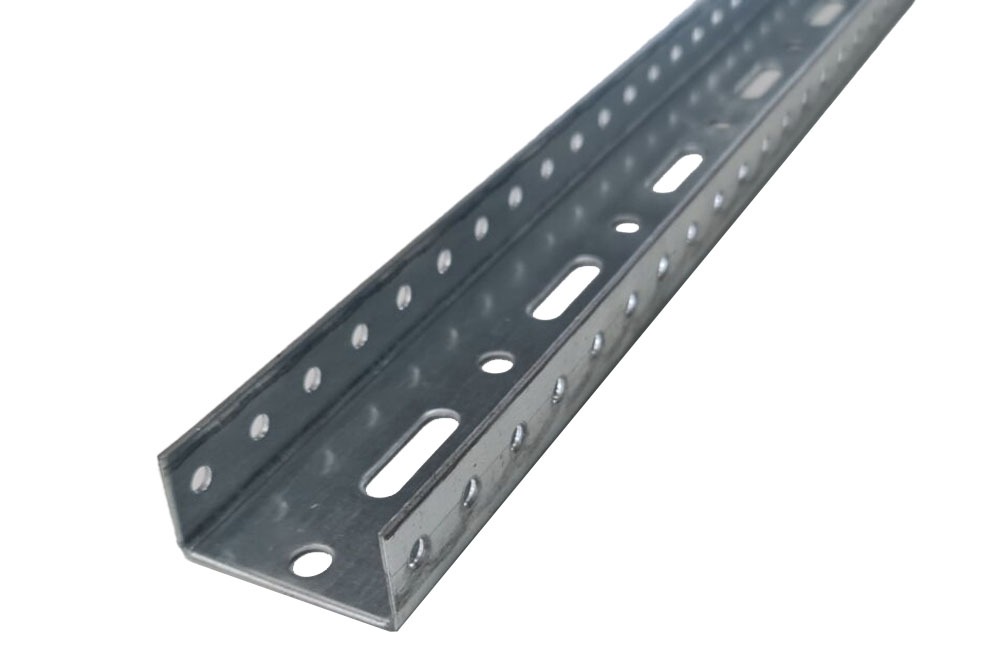
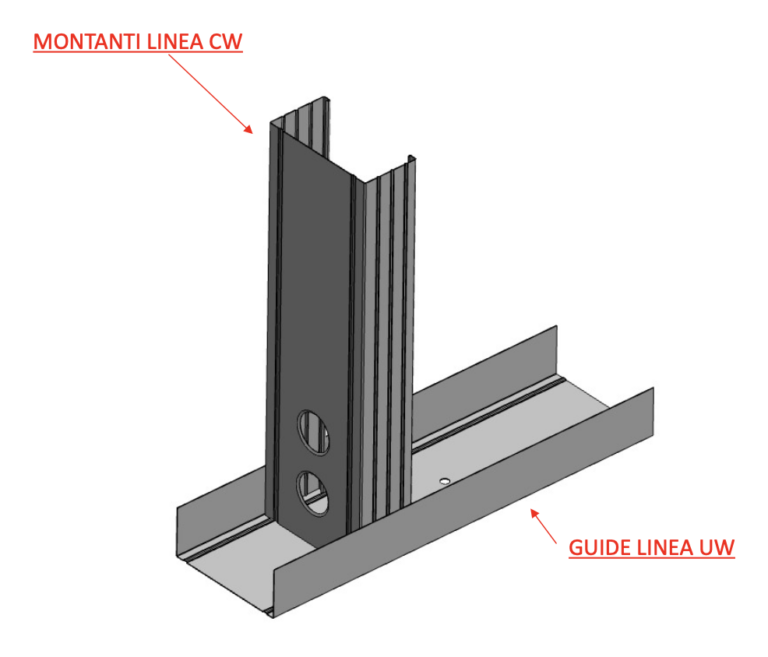
| UW | Tracks for partition walls | 40×50 · 40×75 · 40×100 · 40×150 | 6 holes Ø 7 mm on a 3 m profile |
| CW | Studs for partition walls | 40×50 · 40×75 · 40×100 · 40×150 | 4 service holes Ø 30 mm on a 3 m profile |
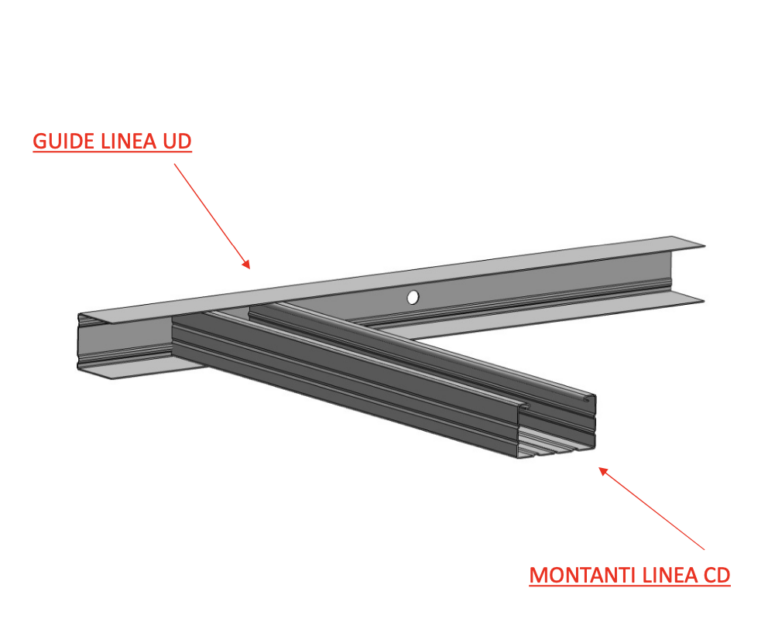
| UD | Perimeter tracks for ceilings and wall linings | 28×20 · 28×28 | 6 holes on a 3 m profile |
| CD | Ceiling channels | 50×27 · 60×20 | No holes |
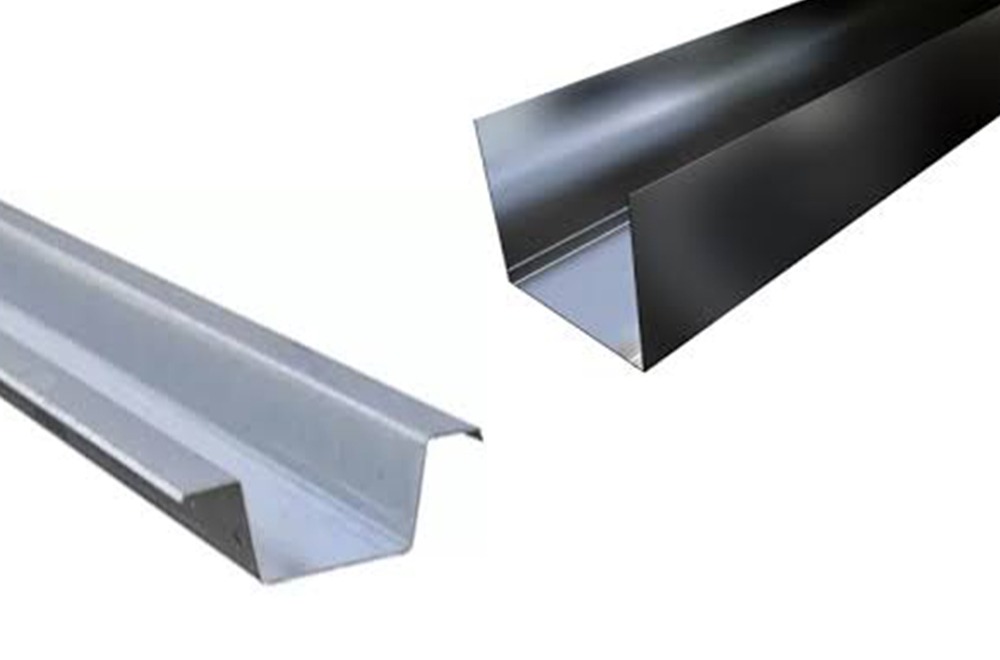
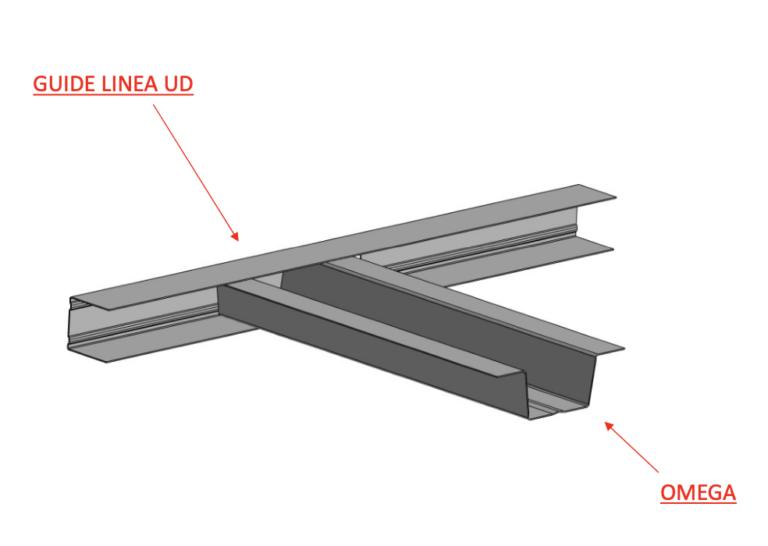
| Omega | Wall linings and ceilings | 42×20 · 42×27 | No holes |

To switch between sizes of the same series (for example from CW 50 to CW 75), the spacers supplied with the roll set are used. Each roll set, complete with cutting dies, is purchased separately: you pay only for the profiles you produce, and you can add more later. Embossing is available as an option on all profiles. Geometries, sizes and thicknesses other than those listed can be designed on request.
How the line works, from coil to finished profile

From the touchscreen PLC the operator sets profile type, length and quantity, or loads a cutting list, also remotely. From there the machine works on its own. If the strip runs out, it stops, signals the alarm with sound and light and, once the coil is reloaded, resumes exactly where it stopped, without losing the order count.
A cheap roll former and a well-built one can produce the same profiles on day one. The difference shows after months of work, and almost always comes from details a quotation does not show:
Before comparing prices, ask these questions to every manufacturer you are considering, including us. Ask for the answers to be written into the quotation.
| Question | Why it matters | oPm’s answer |
|---|---|---|
| Are the upper rolls driven, or only the lower ones? By gears or by chain? | One-sided traction makes the strip slip and piece lengths vary. | Upper and lower rolls, gear transmission. |
| Who designs and who makes the rolls? With which machining? | Imprecise rolls produce out-of-tolerance profiles for the machine’s whole life. | Designed by our engineering department, CNC-machined, high-strength materials. |
| Is there an exit straightener? | Without one, profile flatness depends only on roll adjustment. | Yes, standard. |
| Do cutting and punching leave burrs? | Burrs injure installers and spoil the look of the product. | Hydraulic cutting and punching with dies, burr-free. |
| Who wrote the PLC software? Can you modify it? | With third-party software, every change or fault depends on someone else. | Developed in-house by oPm, modifiable and upgradable. |
| What happens if the strip runs out mid-order? | Restarting from zero means counting pieces by hand and scrap. | The machine stops, signals and resumes where it stopped. |
| Can cutting lists be sent remotely? | It reduces input errors and operator time at the machine. | Yes, at the machine or remotely. |
| How long does a profile changeover take? | Every hour of setup is an hour without production. | Roll change or, as an option, the cassette system: the second cassette is prepared while the machine runs and swapped in a few minutes. |
| What is the real output, not the maximum speed? | Line speed does not account for stops to punch and cut. | With the optional flying cut-off the line runs continuously at ~40 m/min: one 3 m profile about every 4.5 seconds. With the standard cut-off the line stops at each cut, so output is lower and depends on piece length. |
| Which standards does the machine comply with? | The CE mark alone does not say which standards were applied. | Machinery Directive 2006/42/EC, EN ISO 12100, Low Voltage Directive 2014/35/EU, EMC Directive 2014/30/EU, EN 60204-1. |
| Who makes the spare parts, and will they still exist in ten years? | A machine stopped for an unobtainable roll produces nothing. | We make rolls and dies ourselves: spare parts remain available over the years. |
| Can I see my machine producing before paying the balance? | It is the only test that proves what you are buying. | Yes: acceptance test at our premises, producing in your presence (or on video), before the balance. |
| What documentation do I receive? | Without wiring diagrams, every maintenance job becomes a call to the manufacturer. | User manuals, wiring diagrams, maintenance instructions, also in other languages on request. |
| Material | Galvanised steel coil, 0.6 mm thick (other thicknesses on request) |
| Footprint (L × W × H) | ~9.5 × 2.8 × 1.8 m |
| Power supply | 400 V three-phase |
| Motor power | 8 kW |
| Air / oil pressure | 6 bar / 100 bar |
| Maximum speed | ~40 m/min (not equal to actual output) |
| Output with flying cut-off | Continuous, ~1 profile of 3 m every 4.5 seconds |
| Control | Touchscreen PLC with oPm software, sound and light alarms, monitoring sensors |
| Compliance | CE marking, Machinery Directive 2006/42/EC |
On request we also design end-of-line palletising, to collect and stack the finished profiles automatically.

Before delivery, the machine is tested at our premises, producing profiles in front of you. At the same time we train your operators, with theory sessions (operation, safety, PLC software) and hands-on sessions (start-up, adjustment, routine maintenance). Training at oPm’s premises is included.
After installation we stay at your side with preventive and emergency support. Thanks to the remote connection we can monitor the machine and intervene without waiting for a technician to travel. The machine comes with a 12-month warranty.
The standard configuration processes 0.6 mm galvanised steel, the typical thickness of drywall tracks and studs. Other thicknesses are assessed on request.
Yes. The same line produces UW, CW, UD, CD and Omega by fitting the corresponding roll set. With the optional cassette system, a changeover takes a few minutes.
With the optional flying cut-off the line runs continuously at about 40 m/min: one 3 m profile about every 4.5 seconds, a theoretical maximum of about 800 profiles of 3 m per hour. With the standard cut-off the line stops at each cut and output is lower.
No. Length is set on the PLC for each batch, or through cutting lists sent to the machine.
The machine stops and signals the alarm. Once the strip is reloaded, it resumes where it stopped and completes the order.
Yes. Contact us to arrange a demonstration at our premises in Baronissi (Salerno, Italy).
Tell us which profiles you produce, or want to produce, and in what volumes. We will prepare a detailed quotation with every specification in writing, ready to set beside those of other suppliers.
Phone: +39 089 95 55 27 · Email: commerciale@opmstampi.com
Drywall profiles are essential components for building partition walls, suspended ceilings and wall linings. Made of galvanised steel, they form the load-bearing frame the boards are fixed to, and they determine its stability, precision and durability.
Partition walls:
Built by combining UW tracks and CW studs. The frame holds insulation that improves acoustic and thermal performance.

Suspended ceilings:
CD channels, together with UD perimeter tracks, are the main choice for light, accessible ceilings, also with integrated lighting or ventilation.

Wall linings:
Omega profiles let boards be fitted directly onto existing walls, to hide services or correct irregularities.

Light weight, low cost and adaptability have made drywall one of the most widely used solutions in construction and renovation. UW, CW, UD, CD and Omega profiles are the basis of these structures, and the oPm drywall roll forming machine produces them all on a single line.
https://youtu.be/7yu6L_Qt4Qw